Title: Xinjiang: The Construction Of The Core Area Of the Silk Road Economic Belt Is Revitalized

Title: Xinjiang: The Construction Of The Core Area Of the Silk Road Economic Belt Is Revitalized
Xinhua News Agency, Urumqi, October 3 Title: Xinjiang: The construction of the core area of the Silk Road Economic Belt is revitalized Overland routes from ancient times
Xinhua News Agency, Urumqi, October 3, Title: Xinjiang: The construction of the core area of the Silk Road Economic Belt is revitalized
Xinhua News Agency reporter
Xinjiang, located in the heart of Asia, has been an important hub connecting the East and the West on the Silk Road since ancient times. From the land routes in ancient times to the increasingly densely woven three-dimensional transportation network today, as China expands high-level opening up to the outside world, develops the western region, and jointly builds the "One Belt, One Road", Xinjiang has transformed from a relatively closed inland to the forefront of opening up, and is working hard to promote the construction of the core area of the Silk Road Economic Belt.
On September 20, at the 7th China-Eurasia Expo, visitors learned about the "Visit Xinjiang" platform at China Unicom's booth. Photo by Xinhua News Agency reporter Ding Lei
High-quality development helps enrich people and rejuvenate Xinjiang
Autumn is crisp, and it is another harvest season. At the foot of the Tianshan Mountains, the 7th China-Asia-Europe Expo, held in a combined online and offline manner, achieved fruitful results. During the expo from September 19th to 22nd, a total of 448 cooperation projects were signed, with the contract value exceeding 1 trillion yuan, the highest number in all previous expos.
Jiashi County in Xinjiang, located at the southern foothills of the Tianshan Mountains and the western edge of the Taklimakan Desert, was once an important stop on the ancient Silk Road. In the past, due to severe land salinization and scarce cultivated land, many local residents were trapped in poverty. Today, after alleviating poverty, Jiashi County has vigorously promoted rural revitalization with its prosperous melon and fruit industry.
At this expo, Jiashi New Plum and other products exhibited by Jiashi County were favored by the market, and an order of 280 million yuan was signed. According to the person in charge of the local exhibitor, Jiashi County has harvested more than 150,000 tons of new plums this year, which have been sold out. This alone has increased the per capita income of the county's 400,000 farmers by more than 5,000 yuan. At present, relying on various sales methods such as online and offline stores, Jiashi Xinmei sells well all over the country and is exported to Southeast Asia and North America.
Jiashi Xinmei's entry into the international market is the epitome of Xinjiang's unique location advantages and natural resources being transformed into economic and development advantages.
In the past 10 years, Xinjiang has persisted in enriching the people and rejuvenating Xinjiang, promoting high-quality development based on people's livelihood, and built a large number of infrastructure and major industrial projects related to the overall situation and long-term development. Modern agriculture, represented by grain, cotton, fruits and livestock, has entered a stage of efficient and high-quality development.
Currently, Xinjiang’s railway operating mileage reaches 8,768 kilometers, the Heruo Railway is open for operation, and the world’s first desert railway loop has been completed. The total mileage of highways open to traffic has reached 217,300 kilometers, and all prefectures, states and cities have entered the expressway era. The total number of civil airports has reached 24, ranking first in the country in number. The increasingly dense three-dimensional transportation network helps Xinjiang develop rapidly.
June 12, Kashgar Comprehensive Bonded Zone, Xinjiang. Photo by Xinhua News Agency reporter Ding Lei
Create a hot spot for investment and business development
Urumqi International Dry Port Zone, Kashgar Economic Development Zone, Horgos Economic Development Zone... In recent years, the country has established 55 national key opening platforms and industrial development platforms in 13 categories in Xinjiang, and has given a series of policies and measures. As policy dividends continue to be released, Xinjiang has become an important area for industries to move westward and a hot spot for people from all walks of life to invest and start businesses.
Sany Northwest Heavy Industry Co., Ltd., which has "settled" in Urumqi International Dry Port Zone, is the sixth industrial base of Sany Group Co., Ltd. in China. Liu Zhenzhong, general manager of Sany Northwest Heavy Industry, said that with the continuous advancement of the "Belt and Road" initiative, Sany Group has opened a major channel for construction machinery marketing, services and logistics along the Silk Road Economic Belt connecting central and western China to Central Asia and Europe.
Yu Chengzhong, chairman of Xinjiang Horgos Jinyi International Trade (Group) Co., Ltd., started in the fruit and vegetable import and export trade at Horgos Port in the 1990s. Today, his business scope continues to expand to cross-border e-commerce, catering, cinemas, and tourism agriculture. He witnessed the rapid development process of Horgos Port from "channel economy" to "industrial economy" and "port economy".
"In 2010, the central government decided to establish an economic development zone in Horgos. In 2014, Horgos was established as a city. In 2018, the sixth-generation national gate of Horgos was officially opened. At the same time, the state and the autonomous region granted corporate income tax a 'five-year exemption and five-year half reduction' policy, creating good conditions for promoting investment and attracting industrial agglomeration." He said that looking back on the company's growth over the years, it is all riding on the east wind of national policies.
The Kashgar Economic Development Zone was established with the approval of the central government in 2010. It is the fulcrum of southern Xinjiang in the construction of the core area of the Silk Road Economic Belt. As of July this year, there were 4,559 market entities, initially forming a cluster of industries including electronics assembly and processing, textiles and clothing, modern logistics, and trade logistics, providing employment for more than 42,000 people.
Ma Haitao, deputy director of the Kashgar Economic Development Zone Management Committee, said that cross-border e-commerce import and export has become a new highlight in the foreign trade development of the Kashgar Comprehensive Bonded Zone. In February this year, the State Council approved the Kashgar region to become the first comprehensive cross-border e-commerce pilot zone in southern Xinjiang. This not only provided policy dividends for cross-border e-commerce settled in the Kashgar Comprehensive Bonded Zone, but also ushered in new opportunities for the development of Kashgar's export-oriented economy.
"By giving full play to our policy advantages, we will strive to achieve the goal of 20 million cross-border e-commerce transactions and a goods value of 600 million yuan this year," Ma Haitao said.
On January 11, employees of Xinjiang Meixu Textile Co., Ltd. were busy in the workshop at the Industry-City Integration Park in Moyu County, Xinjiang. Photo by Xinhua News Agency reporter Ding Lei
Regional cooperation welcomes new opportunities for development
Mao Hui, deputy director of the Development and Reform Commission of the Xinjiang Uygur Autonomous Region, said that in recent years, Xinjiang has used the construction of the core area of the Silk Road Economic Belt as an engine, actively integrated its own regional opening strategy into the country's overall layout of opening to the west, actively carried out foreign exchanges and cooperation, and achieved remarkable results, and the "circle of friends" for Eurasian cooperation has continued to expand.
So far, Xinjiang has signed 21 cooperation agreements with 25 countries and international organizations, established economic and trade relations with 176 countries and regions, and established 45 pairs of international sister cities. Foreign investment has covered more than 60 countries and regions, and 4 overseas economic and trade cooperation parks have been built.
In July this year, representatives of the business community in China from 13 countries visited Xinjiang. They said that Xinjiang has outstanding geographical advantages and huge development potential in the joint construction of the "Belt and Road". They look forward to carrying out more practical cooperation with Xinjiang, actively promoting host countries to strengthen cooperation with China's Xinjiang in various fields, and promoting mutually beneficial and win-win development.
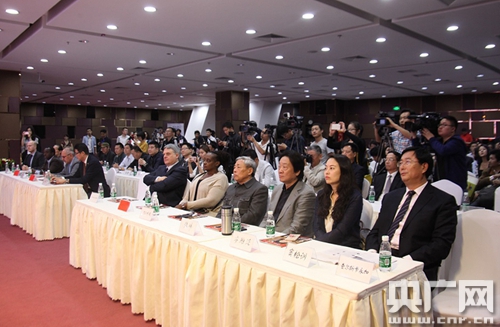
At the 2022 Silk Road Economic Belt Core Area Development Summit Forum held during the Seventh China-Eurasia Expo, Lin Yifu, dean of the Institute of New Structural Economics at Peking University, believed that under the new development pattern, Xinjiang will make full use of its own natural resources, labor endowment advantages, and location advantages in the core area of the Silk Road Economic Belt. It will surely be able to seize a once-in-a-lifetime opportunity, usher in economic take-off, and contribute to the further development of Xinjiang's economy and the great rejuvenation of the Chinese nation. (Reporters: Ding Jiangang, Deng Yushan, Pan Ying, Zhou Shengbin)
Producers: Zhao Danping, Li Zhiang
Coordinator: Li Kai, Hou Dongtao, Qin Dajun, Xia Xiaopeng
Produced by Xinhua News Agency International Communication Integration Platform