Wang Wen’s Dialogue With Former Polish Deputy Prime Minister Koledek: Superpowers Can Use Military Power To Expand Their Influence, But China Has Not Done So

Wang Wen’s Dialogue With Former Polish Deputy Prime Minister Koledek: Superpowers Can Use Military Power To Expand Their Influence, But China Has Not Done So
Welcome, Professor Koledek. I know you are influential and knowledgeable. But today we will focus on the international system and international change. Let’s start with your country, Poland. Some time ago, Poland closed the border ports for China-Europe freight trains (from September 12 to September 25
Welcome, Professor Koledek. I know you are influential and knowledgeable. But today we will focus on the international system and international change.
Let’s start with your country, Poland. Some time ago, Poland closed its border crossings for China-Europe freight trains (from September 12 to September 25, but has now been restored, editor's note). This has had a great impact on the development of China’s economy and the “One Belt, One Road” initiative. What happened in Poland? How do you view the development of Poland and its relations with China?
Koledek: I think this is a serious mistake on the part of the Polish government. Although I am not 100% sure, I speculate that this was an impulsive decision that failed to fully consider the harm it might cause to China's economy and other aspects.
Relations between Poland and Belarus are highly strained over two issues. One is uncontrolled migration. Some people use the border between Belarus and Poland to first enter Poland and thus enter the EU. The second issue is the war in Ukraine. The situation on Poland's eastern border, including the 373-kilometer border with Belarus, is quite tense.
But I think the Polish government’s decision to close the border is not very wise, and it is certainly not against China’s interests. Polish leaders know this would hurt China's interests, as China-Europe trains run from China through parts of Asia, then through Russia and Belarus, and into the EU through Poland. So as I said in my opinion article, if Poland wants to be China’s gateway to the EU, it should not close its door. There should be diplomatic communication instead of impulsive politics. The Chinese Foreign Minister, Mr. Wang Yi, did visit Poland and he met with the Polish Foreign Minister. A few days later, the border reopened. The Polish government’s justification is that the reasons for closing the border no longer exist. But in fact, I think the Polish government admitted in this way that it was Poland's mistake, which is regrettable.

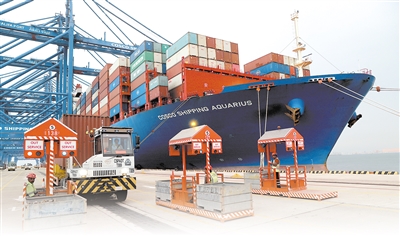
When the border ports between Poland and Belarus were briefly closed, a batch of China-Europe freight trains was backlogged at the ports.
Populism is growing in Poland and Central and Eastern Europe
Wang Wen: I think so too. But the problem is that in the past few years, the China policies of Central and Eastern European countries, including Poland, seem confusing. For example, not only Poland, but also Lithuania or some other countries have an unfriendly attitude towards China. Now the "17 1" leaders' meeting mechanism between China and Central and Eastern Europe is also facing difficulties. You are known to have had a huge influence on Poland's economic transformation, and many professors describe you as the architect of Poland's economic transformation. So, let’s talk about the transformation of Central and Eastern European countries.
Koledek: This is a very big issue. My country, Poland, is considered a success story not only in Eastern Europe, but throughout the world. If you look only at long-term data, our GDP - which is the basic measure of economic growth - has tripled since the political changes in 1989, which is a remarkable achievement from a European perspective. But it might not be so impressive if you look at it from a Chinese perspective, which is developing much faster.
But the first point is that we could have done better if not for the policy mistakes made in the early stages of the transition, especially the so-called "shock therapy." I sometimes say it's more like "just shock, no therapy."
The second important issue is that the transformation in countries such as China or Vietnam is very different from that in Eastern Europe. The difference is that while we are transforming our economy, we are also reforming our political system. In my country, the debate is never-ending, do this or do that, they call it democracy. The result is no new railways, no new bridges, no new nuclear power plants, etc. As a result, some decision-making processes have been slow and not as efficient as China's mobilized democracy, and political tensions within the government have slowed economic progress.
So the question is, how do means serve the end? As a development economist, and from the perspective of one of the so-called key architects of Poland's economic success, the political system should be seen as a tool to achieve an end. This end is the well-being of the people and the country's sustainable social, economic and environmental development, rather than putting the cart before the horse. Economic policy will be less effective if it is subordinated to the politics of power struggles. Because of this, some countries in Eastern Europe have not achieved the level of success they might have achieved.
Also in Poland, the decision to close the border with Poland and Belarus that I just mentioned is harmful to China's exports and so on. This decision had economic consequences, but it was based not on economic considerations but on political sentiment. So, if decisions are driven by emotion rather than intelligence or common sense, there will be inefficiencies, financial mistakes, etc. from time to time. A new problem that has emerged in recent years is the resurgence of nationalism and populism in some Eastern European countries, which is also very detrimental.
Until recently, the liberal-oriented party at the heart of Poland's coalition government has also turned nationalistic. Our Prime Minister has declared that it is time to end childish globalization and to practice modern economic nationalism. I say this is a very serious mistake and we should not move towards any form of nationalism. We should move towards further openness, taking advantage of the global exchange of technology, goods and to some extent labor force, and towards inclusive globalization. But now, xenophobia, nationalism, and populist sentiments are growing not only in Eastern European countries, but also in several Western European countries. This is a very negative factor for economic development.
Ignoring Draghi report recommendations, EU follows US in increasing military spending
Wang Wen: Yes, this is exactly what I want to ask you next. Many Chinese scholars believe that 20 or even 30 years ago, after the end of the Cold War, Poland and other Central and Eastern European countries served as role models for our transformation. But in the past three decades, transformation has included not only economic transformation, but also political transformation. At first, we thought these countries might be very successful, but now it seems... you know, the first time I went to Central and Eastern European countries, such as Poland, Hungary, the Czech Republic, etc., was 20 years ago, when they were at a similar level of development to China. But I went to some of these countries last year and saw that their economic conditions were not very good. As you mentioned, they have "democracy" but "democracy" does not promote enough development. So, in your opinion, is this the pain of transformation? What is the future of transformation in Central and Eastern European countries?
Koledek: That's another complicated question. You have to realize that most Eastern European countries are relatively developed countries. According to the terminology and methodology of the World Bank and the International Monetary Fund, Poland belongs to the so-called advanced economies. As early as 10 or 12 years ago, our per capita GDP (on a purchasing power parity basis) was more than twice the world average. The higher the income, the slower the growth. This is a factor.
But despite this, the Polish economy, for example, has grown by more than 3% annually in recent years. However, it seems to me that growth could have been faster if economic policy had always been based on knowledge rather than being constantly influenced by emotions.
The second factor is that you mentioned the end of the Cold War. But some people over the past few years have said that was the end of the first Cold War because now we have a second Cold War. This Cold War was initiated by the United States against China, although there was no formal declaration of war. You must realize that most Eastern European countries (excluding post-Soviet powers such as Ukraine, Belarus, and Moldova) have already joined the EU and NATO, a political and military alliance.
Nowadays, due to the tensions within the framework of the new Cold War and the outbreak of the Russia-Ukraine crisis, the tensions are more serious than before, and we are spending huge amounts on so-called national defense construction. The reason why I say "so-called" is because even if one country attacks another country, it claims to be defending. Both the current and former Polish governments are very proud of this: Among the 32 NATO member states, our defense expenditure ranks first in the proportion of GDP, and we will increase military expenditure to 5% of GDP.
But our investment in R&D funds is less than 30% of military expenditures. The same is true across the EU, including these post-socialist transition countries. If a country's military spending is more than three times its R&D investment, it cannot achieve long-term economic growth.
More than a year ago, there was a "Draghi Report" submitted by Draghi, the former Italian Prime Minister and former President of the European Central Bank. The report proved that the EU, including new members and the transition economies in Eastern Europe, was losing competitiveness to its two "new big brothers", the United States and China. Draghi and her team recommend a significant increase in investment in research and development to make the European economy more competitive.
What did we do? We did not heed the recommendations of the Draghi report. We followed the advice of the President of the United States and increased military spending to 5% of GDP. From an economic competitiveness perspective, this is mostly a waste of money. The slowing pace of growth is therefore also a result of the Second Cold War. The question is how to get out of this predicament. And now, I worry that the spiral in military spending will intensify even further.

On September 3, Trump met with Polish President Karol Navotsky at the White House.
"The European-American Union and the Eurasian Union, Europe is a part of it."
Wang Wen: Yes, this is exactly what many Chinese people think - this pro-American policy or transformation, as you said, comes at a huge cost. The crisis in Ukraine has now been going on for more than three years. In my opinion, it might last longer. This is a huge price not only for Poland but also for other European countries. So my question to you is, what impact will this have on European countries in the long term?
Koledek: Not long ago, the very influential British weekly The Economist and its affiliated Economist Intelligence Unit expressed a view: Looking into the future, the world will be divided into the West led by the United States and the East led by China and Russia; and these two worlds will often conflict and sometimes even use military means to expand their influence in the global South.
I don't agree with this view. You know, the so-called "East" led by China and Russia, Russia is actually just China's "little brother" due to its weak economy and many other reasons. In the so-called Eastern camp, we also have a very important country - India, whose future development will become increasingly important. So, I'm very concerned about China, India and China's relationship with global development.
My view is contrary to that of The Economist. I believe that the future of the world is not a conflict between the West and the East, or unfriendly or even hostile competition for influence in the Global South, but a world composed of two "super domains": one is the Euro-American-Atlantic domain, dominated by the United States; the other is the Eurasian domain, in which the most important position will be occupied by China. And Europe is an integral part of both. We are undoubtedly part of Europe and America, but there is no doubt that we are also part of Eurasia.
Therefore, the smart strategy in the geopolitical game is that the EU (including Poland) should not be incited by US preferences and move toward xenophobia, suspicion of China, or anti-China policies. We should not get involved in the Cold War and trade war between China and the United States. We should maintain good relations with both North America and China and be committed to peaceful cooperation. This also includes responding to some initiatives put forward by Chinese leaders, such as the Global Development Initiative and the Global Governance Initiative, which aim to promote inclusive globalization, which is what you in China call "win-win globalization." But this is contrary to the current interests of the United States.
You have to realize that the policies we have now (meaning those countries you mentioned, maybe Hungary and Slovakia are a little better, but countries like Poland and the Czech Republic) are very much influenced by American priorities. You know, that’s what New Big Brother does. From a personal perspective, I'm very critical of this. I think Poland's political leadership is too amenable to American pressure.
I can give you many examples. I used to use Huawei mobile phones. When China proposed investing in a broadband 5G network in Poland, yes, it was China's Huawei technology, which is one of the top technologies in the world. We were told by the US government: If you accept China's Huawei network, the US will not station troops in Poland. As a result, we now have a US military base in Poland, but we do not have Huawei’s technology. Unfortunately, this is an example of how economics and politics work today. So when I wanted a new phone, I went to the store and asked if Huawei was available, and they told me: "Sir, there is no Huawei anymore. Do you know why there is no more? Because of political tensions." So you see, something in the economic sphere is again being driven by political preferences, which is contrary to economic logic.
The question is how to get rid of this dilemma, how to get rid of the Cold War mentality, how to get rid of this new nationalism and protectionism? This is extremely difficult in the context of the current US administration (Trump 2.0 era).
I just published a book about the new American government that is being released in multiple languages. The Trump 2.0 government is very destructive to the world order and even to the United States itself. Mr. Trump’s belief that he will make America great again, or even greater, is dead wrong.
The conflicts we are currently involved in, provoked by American hegemony, will ultimately only weaken us, with China emerging as the winner. Because China has many capabilities, one of which is the ability to plan for the long term. Now you are discussing the 15th Five-Year Plan from 2026 to 2030. China's leadership and China's economists see these five years as another step in the long journey toward a better future. And this is what most of us in Central and Eastern Europe, and even the European Union, lack.
Our policies do not take a long-term view and are still focused only on the next election. You can see the problem just by looking at France. No one really knows who is prime minister in France now because governments change so frequently. You know, Germany and the UK have similar situations. If general elections are held in the UK and Germany this Sunday, both Keir Starmer and Friedrich Mertz will face a political crisis. So, this is what democracies sometimes lead to. Democracy is a good thing for many of us, but sometimes it makes economic rationality that much more difficult.
Globalization is irreversible, but political globalization has fallen behind
Wang Wen: A few years ago you mentioned that today’s globalization has entered a period of neorealism, and just now you mentioned the Second Cold War. In the past, many Chinese people imagined that the world would continue to progress. But now it seems that the world seems to be going backwards under certain conditions or in certain areas, and sometimes it is even getting worse. So, what is happening in the world today? What new observations do you have about the current state of the world?
Koledek: I still stand by my judgment: According to my understanding, globalization is irreversible. The biggest problem is that before the current wave of protectionism, trade wars, and the Second Cold War, political globalization had already lagged behind economic globalization.

Former Deputy Prime Minister and Finance Minister of Poland Koledek
We have created an intertwined, interconnected global economy. What happens in China depends largely on the European market, which in turn has consequences for countries further afield such as Brazil, Indonesia or Nigeria. We in the global village are interconnected due to the flow and exchange of technology, capital, human resources, and knowledge and ideas. However, political globalization has lagged behind. There are indeed problems in global governance and institutionalization of rules, that is, in redesigning the rules of the game for the global economy.
You know, institutions are very important. This is one perspective from which I look at the problem from the perspective of the Global Governance Initiative. This is largely a search for answers: How to govern the global economy? We do not have a global government and we never will have a global government. But we do have a global economy. Therefore, the problem is how to coordinate economic policies, investment policies, trade policies, and technology policies between regions, countries, and enterprises. We built some structures after World War II and some international structures after the end of the first Cold War, but these are no longer adequate to meet current challenges.
So what next? I think we must learn from the mistakes we are currently making, that is, nationalism and protectionism are not good for development. Even from a nationalist point of view it raises a lot of questions. If we want to make progress, we must call for new ways of thinking and new leadership.
As you said before, what we have believed for many years is that one cannot just dream, but one must have a vision. But this is not enough. If you have a vision, you need a strategy. I did have a vision, so I developed a strategy for Poland. Next, you need leadership. The question is, where does leadership come from in trying to improve global economic and political governance? This is still far away. Things will eventually get better. But before that happens, things get worse.
"Everything possible must be done to stem the tide of military expansionism"
Wang Wen: Yes. In the past, many Chinese looked up to the United States as a global leader. Maybe people in most countries think so. But the thing is, we're very disappointed in America these days. Now, they have lost their global leadership and turned their backs on so many international institutions. What do you think about this? Because I just read your new book "Trump 2.0", in my opinion, you are the first scholar in the world to have an in-depth observation of the Trump 2.0 phenomenon. The book is not thick, but you describe very clearly the disastrous impact that Trump 2.0 will have on the world. What happened in the United States? What kind of impact will Trump 2.0 bring to the world?
Koledek: The subtitle of my book "Trump 2.0" is "Global Turbulence and Power Shifts," and the content largely revolves around this theme. You know, the 47th President of the United States, he certainly does not understand the complexity of global economics and politics. Even if he understands a little bit of contemporary world economics and politics, he cannot accept it, because from his perspective, a powerful China is unacceptable to him.
The driving force behind Trumponomics and Trumpism is not just the economic policies that President Trump says are designed to contain China. He believes that China's expansion poses a risk to world peace and sustainable development, a view that I do not share. Of course, many of China’s external activities since launching the “One Belt, One Road” initiative are not charity. Whether building a road in Kenya, a railway in Poland or a port in Peru, it is not a gift or charity. But this is in line with what China calls the concept of "win-win and mutual benefit": it promotes economic development while maintaining China's development, but not at the expense of other countries, but achieving positive synergies with other countries. It’s a win-win, the exact opposite of Trump’s philosophy (if you can call it that).
Because he claimed, or rather shouted, "America First." Well, if America comes first, that means everyone else should come next. However, much of the world no longer accepts American leadership. People are tired of talking about a "rules-based world order," especially when the U.S. government itself doesn't follow the rules.
This surprises many of us - China and some other countries are now the defenders of the "rules-based world order". Due to the inappropriate behavior of the United States, there are indeed problems in the operation of international organizations such as the World Trade Organization, the World Health Organization, and UNESCO (responsible for cultural and educational affairs). So, what is the root of the problem? The root lies in a long-standing conflict between the two views.
We have different philosophies and different interests. Sometimes conflicts of interest are confused with conflicts of ideas. In the West, they claim that they are safeguarding democracy and human rights. But in fact, they are protecting the interests of the military-industrial complex and so on. That's how it went. Therefore, this requires greater involvement of intellectuals, academia, and independent media to expose this hegemonism, nationalism, and national egoism.
But this is easier said than done. So I think things will change, but I'm afraid it will take several years. It may take more than ten years, maybe twenty years or so, before things get back on track like they did after the end of the first Cold War.
For example, between 1987 and 1998, global military spending was cut by about one-third, and the huge amount of money saved at that time—about 600 billion U.S. dollars, which would be more than 1 trillion U.S. dollars in today’s terms—was diverted from defense and military construction to funding development. Poland was also a beneficiary of that process. And China, without the end of the Cold War, would not have achieved the success it has today.
But now, the second Cold War has made things much more difficult. Therefore, everything possible must be done to stop this madness, this frenzy of military expansionism that goes against common sense.

From 1987 to 1998, global military spending fell by 30%. The picture shows global military spending from 1949 to 2023 and the proportion of military spending in major economies.
The world is big enough to accommodate two different political systems
Wang Wen: But when we observe the changes in the United States, we do find that this country is no longer what we imagined in the past. This is why more and more people are beginning to reflect on the quality of democracy in the United States, repeatedly thinking about the economic advantages of the United States, and re-examining the marketization of the United States. We are seeing more of their shortcomings.
We all know that Francis Fukuyama proposed the "end of history" more than 30 years ago. But now is precisely the amazing turning point of the "end of history" and new history. The "Washington Consensus" he advocated is ending, right?
Koledek: History never ends. The title of Francis Fukuyama's book "The End of History" is clever - it was the "end of history" theory that made him famous. But history continues, because history is the chronicle of conflict. As I said, this is a natural law, and there will inevitably be a confrontation of ideas under conflicts of interest. The key lies in how to resolve conflicts in a peaceful manner to promote sustainable development. This is entirely possible, but only if there is dialogue.
But you need to understand that we are in China at the moment. But in Western Europe - and now even Eastern Europe - suspicion of China is rampant, especially in the United States. If asked about China's intentions, President Xi Jinping and most Chinese people would emphasize peaceful development and mutual benefit. However, if you ask people in Poland, Germany, the United States or Japan, many people will assert that "China seeks hegemony" and "wants to impose its will on others." While no one has yet accused China of trying to force the West to use chopsticks, I wouldn't be surprised if politicians speculated that way.
The core question is: What are the true intentions of leaders of different political civilization systems? To what extent are their agendas compatible? Reality is often filled with contradictions rather than harmony. When countries all shout "America First," "Long Live France," "Germany First," or "Poland for the Poles," confrontation replaces tolerance. Don’t we need a more open, inclusive, and respectful world?
For this reason, the more people-to-people exchanges the better. I look forward to more Chinese students going to Poland to study, and more Poles coming to China not only for business but also for tourism. I don’t understand why LOT Polish Airlines canceled the direct route from Warsaw to Beijing. The so-called “economic rationality” explanation is unconvincing – although this is a small move, it represents the wrong direction.
Perhaps this is the law of development: when good times last too long, certain problems will lose rational control. China's rise is undoubtedly an important inducement. Germany, France and Japan have not fully accepted it, especially the United States. I must emphasize here - and please listeners remember - that the Russo-Ukrainian war seriously damaged the international atmosphere, and it has become increasingly difficult to talk about peace and cooperation in various regions of the world.
The West is losing its monopoly on explaining the path of economic development
Wang Wen: But frankly speaking, I think a key point and a key reason why many Western countries fail to accept the rise of China lies in theoretical limitations. Because they cannot theoretically imagine the rise of a more civilized country. Today, a small number of Chinese political scholars believe that China's rise is a process with more civilizational connotations than that of Western countries. You know, we did not start a war, carry out colonization, or plunder the wealth of other countries. We just work hard and try our best to promote cooperation, such as the Belt and Road Initiative. If you are willing to cooperate, we are very happy; if you are not willing to cooperate, no problem, we can wait. So I think China's rise is more civilized than other countries.
But the problem is that Western theories often apply their own experiences and theories to describe and imagine the future of China's rise, thus creating a sense of threat or anxiety about China. So I want to ask you, as an outstanding theoretical scholar who has been paying attention to China's development for a long time, in your opinion, do today's Western theories - I mean Western academic circles including all social sciences - explain the rise of China well? Or are they facing confusion or dilemmas caused by theoretical limitations? What do you think about this?
Koledek: Any progress and development, including economic development, are inseparable from ambition. But the problem and challenge is that we have healthy ambitions and sometimes pathological ambitions - and these two different types of ambitions are the engines that drive different behaviors. The second point is that the mainstream narrative circle in the West has always claimed and still claims that only democratic regimes are conducive to development, while authoritarian systems are not conducive to development.
However, today's China, a country that does not meet the so-called "democracy" standards of the West, is proving with remarkable achievements that it can achieve great economic success without Western-style democracy. This makes the West nervous. We are losing - indeed have already lost - our monopoly on interpreting the path of economic development, claiming that democracy is compatible with development and that non-democratic institutions are incompatible with development. Because there are systems in the world that are not Western-style democracies – not just in China, but also in countries with different political systems such as Vietnam, Singapore, Qatar or the United Arab Emirates – that have also achieved economic progress.
But there is a proviso: it must be combined with meritocracy. The subtlety of the Chinese system—I call it “Chinese characteristics” because, in my opinion, it is neither pure communism nor typical capitalism, but a new category—is that you can actively combine the power of the market’s “invisible hand” with the power of the government’s “visible hand” in a very unique and successful way.
So other countries will be jealous and they will want to follow suit. But combining these two forces requires another ingredient: you need a class of meritocratic leaders. This requires a special culture, and this approach is quite Chinese. So countries like Indonesia, Pakistan, Egypt or Algeria may be able to learn from it to some extent, but certainly not countries like the UK or the US, which will stick to their own path. The question is, will the future world be broad enough to accommodate different political systems that promote economic development in different ways? I think this is possible.

Drones have become a tool of war in some countries, but in peaceful China, they are a fireworks display that people flock to during the New Year and festivals.
But that is not currently the case. We now have two kinds of "correctness": one is the so-called "political correctness" and the other is "economic correctness". My views are considered "politically incorrect" in Poland. I can’t say too many good things about China because it is inconsistent with “political correctness” – because “China is not a democracy”, “China may dream of hegemony” and so on. But I don’t want to pursue this kind of “political correctness,” because today’s “political correctness” means primarily being pro-American and suspicious of China. This is very irrational. I would like to ask, during President Trump’s administration, how can we be pro-American and at the same time consider China’s contribution to the development of other economies, but still be skeptical of China?
Wang Wen: This does seem like a double standard. You know, if you hold a lot of pro-American views, no one is going to criticize you. But as a Western scholar, if you express too many pro-China opinions, they will criticize you. This is a double standard. But you just mentioned a very interesting term that you coined, which is "Chinese characteristics." This is a bit like "Chinese exceptionalism." This reflects the poverty of Western theory, which to some extent means that Western theory cannot explain China's development well.
So, let’s look back at China’s development experience. You have observed China's development experience for many years, especially since the reform and opening up in 1978. We have followed our own path, explored our own path, and created a lot of development experience. How do you evaluate China’s development experience and its theoretical summary? Are there any new theoretical developments in studying China?
Koledek: I think China’s position is different from the Soviet Union’s position a few years ago, and also different from the U.S. position until recently. China does not intend to impose its systems and values on others, especially not through force. About 35 to 50 years ago, the Soviet Union tried to impose its system on some countries in Eastern Europe, North Africa, sub-Saharan Africa, and the Middle East. To a certain extent, and for a while, it was successful. But ultimately, this led to the collapse of the Soviet system, the dissipation of Soviet influence, and the disintegration of the Soviet Union itself.
History is different now because history continues, this is not the end of history. So the question is, how committed are China's values, China's systems, and China's leadership to a multipolar world and pluralism? Is this just a verbal statement, or is it a real political attitude and vision?
Some people say that Chinese leaders do not shout "China First" like Mr. Trump shouts "America First", but others say that although China does not say it clearly, this is what it means? I'm not so sure about this. But what I am sure of is that the Chinese leadership's primary concern is China's future, China's interests, but at the same time it is also looking for positive synergies with the rest of the world.
Furthermore, the essence of any policy, including economic policy and defense policy, is to avoid escalating situations of disagreement into open conflict. We don’t have to fight each other. Even if a win-win situation is not possible, we can deal with the problem in a more rational and peaceful way. However, ambition in this regard must be restrained. We must move away from unhealthy trends and distinguish between what is truly good for us and what is merely good for others who are simply manipulating our political agenda.
NATO, for example, has been telling the public that its military expansion is necessary on the grounds that we face the risk of being invaded—if not by China, then by Putin’s Russia. Most people do believe this rhetoric. But I don't agree. I think this is pure nonsense, because in order to invade another country, two conditions must be met:
First, there must be the intention to invade; second, there must be the ability to invade. I do not believe that Russia has the intention to invade any European member of NATO because such an invasion would not be in its interests. At the same time, it does not have the ability to conquer NATO.
However, public sentiment has been fanned to a boiling point, arguing that we must build up our armaments because that is the only way to ensure security, rather than relying more on diplomacy. As a result, diplomacy is put on hold and impulsive decision-making ensues.
The closure of the Bosnia-Belarus border we mentioned at the beginning of our discussion did not fully consider the problems it would cause by blocking the China-Europe freight trains. This is simply terrible. You know, as a sane person, a professional economist and a democrat, I just have a hard time understanding how this pathological ambition can even be such a powerful driving force behind economic decisions.