Make Up For Shortcomings And Jointly Build The “Belt And Road” With High Quality

Make Up For Shortcomings And Jointly Build The “Belt And Road” With High Quality
From hard connectivity to "soft and hard connectivity", from project cooperation to industrial ecological co-construction, from economic orientation to multi-dimensional upgrades of multi-goal collaboration... In recent years, the joint construction of the "Belt and Road" has been consistent with the trend of global sustainable development.
From hard connectivity to "soft and hard connectivity", from project cooperation to industrial ecological co-construction, from economic orientation to multi-dimensional upgrades of multi-goal collaboration... In recent years, the joint construction of the "Belt and Road" has been consistent with the trend of global sustainable development, demonstrating China's responsibility in promoting the construction of a community with a shared future for mankind.
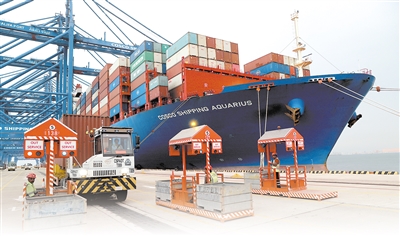
The Fourth Plenary Session of the 20th Central Committee of the Communist Party of China proposed "high-quality joint construction of the 'Belt and Road'". In the past five years, hard connectivity of infrastructure and soft connectivity of rules and standards have worked together. China-Europe freight trains have operated more than 100,000 times, and China has signed 113 standardization cooperation documents with 69 countries and organizations. The co-construction of industrial ecology has achieved remarkable results, and the platform industrial ecology with industrial parks as the carrier is becoming increasingly perfect. Multiple goals have been implemented collaboratively. A number of benchmark projects such as the China-Laos Railway and the Morula Wind Farm in Montenegro have been coordinated through economic empowerment, environmental improvement and social development, vividly interpreting the multi-goal balanced practice of jointly building the "Belt and Road".
High-quality joint construction of the Belt and Road Initiative is inseparable from policy innovation and empowerment. In 2022, my country's "Opinions on Promoting Green Development in the Joint Construction of the "Belt and Road"" encourages companies to carry out economic and trade activities with strict environmental standards that exceed those of host countries, making green the background of the joint construction of the "Belt and Road". The 2024 "Opinions on the Reform, Innovation and Development of Digital Trade" promotes the facilitation of cross-border data flows and drives the digital transformation of industries in the jointly built country.
It should also be noted that the joint construction of the "Belt and Road" still faces some structural shortcomings in the process of leaping to high quality. In terms of "soft and hard connectivity", the fragmentation of rules and standards in various countries is still obvious, and soft connectivity such as green certification and cross-border data flow obviously lags behind infrastructure hard connectivity. In terms of co-construction of industrial ecology, the localization supporting rate in some co-construction countries is low, and the synergy effect of the industrial chain is limited. In terms of multi-objective coordination, the cost and financing difficulties of green transformation, the mismatch between some livelihood projects and local needs, and the pressure of potential ecological risks still pose challenges to the high-quality Belt and Road Initiative.
At the industrial level, we should focus on key areas such as digital economy and trade and green development, unite countries to formulate unified norms, promote the establishment of a mutual recognition alliance for "Belt and Road" rules and standards, and strengthen coordination among countries on soft connectivity. A normalized cross-border collaboration mechanism will be formed around the construction of the "Belt and Road" industrial ecology. Through multilateral financial institutions such as the AIIB and the New Development Bank and regional special funds such as the Silk Road Fund, we will increase financing support for the "upstream and downstream supporting industry-university-research linkage" ecology of cooperation parks, promote emerging industrial clusters such as photovoltaics, energy storage, and artificial intelligence to go global, promote a development structure that integrates the "train park e-commerce" model and the "digital intelligence green" path, and promote the in-depth reconstruction of the industrial ecology. Through the policy coordination of jointly building the country, we will increase the weight of green, low-carbon and people's livelihood benefits in the project evaluation system, and enhance the green attributes and inclusive attributes of financing tools.
At the enterprise level, the transition from "going out" to "integrating in" should be completed as soon as possible. Advantageous enterprises should actively participate in the formulation of international standards and help connect standards between China and co-building countries. They can use cooperation mechanisms such as "Silk Road E-commerce" to expand the market and promote mutual recognition of product standards. Enterprises with rich experience in park operation should increase their layout in the direction of the “Belt and Road” and help form a new industrial ecology. In the process of enterprise localization, we encourage the formation of a new model of "Luban Workshop Enterprise" to meet the needs of enterprises for professional skills talents. Regard high-level ESG (environmental, social and corporate governance) as a core competitive advantage and actively respond to the "Beyond the Host Country Principle".
At the consumer level, digital consumption connectivity is the focus of soft connectivity, combining digital payment with RMB internationalization, expanding the cross-border application scenarios of digital RMB, and promoting the pilot model of "digital RMB cross-border e-commerce" in a timely manner. Provide preferential policies to consumers who purchase green products, help jointly build national characteristic products to enter the Chinese market through "Silk Road E-commerce" live streaming and other models, and promote the reshaping of the "Belt and Road" industrial ecology through green transformation on the consumer side. Deepen people-to-people and cultural exchanges along the Belt and Road Initiative, spread the concept of consultation, collaboration and sharing, and focus on the consumption experience for new generations such as Generation Z to make consumption more inclusive and beneficial to all. (Source of this article: Economic Daily Author: Huang Youxing)